




Key Takeaway
Most Pakistanis under-apply sunscreen by half. Here's the two-finger rule in grams, teaspoons and real product amounts — plus reapplication timing for Karachi, Lahore and Islamabad.
How much sunscreen to apply in Pakistan is simpler than most people think, and most people are applying far less than they should — the fix is the two-finger rule: two full finger-lengths of sunscreen, squeezed along your index and middle finger, cover your face, neck and ears at the thickness that actually delivers the SPF printed on the bottle.
This guide breaks that rule into grams, teaspoons and real product amounts, then covers body application and reapplication timing for Karachi's humidity and Lahore or Islamabad's dry heat.
What the Two-Finger Rule Actually Means
The two-finger rule comes from a real clinical measurement: sunscreen SPF numbers are tested in a lab at a thickness of 2 milligrams per square centimetre of skin, known as a finger-tip unit (FTU). Most people apply far less than that — closer to 0.5-1mg/cm² — which is why a sunscreen labelled SPF 50 often behaves like SPF 15-20 on real skin.
The two-finger rule translates that lab number into something you can measure without a scale. Squeeze sunscreen along the full length of your index finger, from the tip to the first crease at the base, then do the same along your middle finger. That combined amount — roughly 1.2 to 1.3 grams — is enough to cover an average adult face, neck and ears at the tested protective thickness. It is noticeably more product than most people are used to applying, and that is the point: under-application, not the wrong SPF number, is the most common reason sunscreen fails to protect Pakistani skin from tanning, dark spots and sun damage.
How Much Is That in Teaspoons and Rupees
In household terms, two finger-lengths of sunscreen is close to a quarter to a third of a teaspoon (about 1.2-1.5ml) for the face, neck and ears combined. If you separate zones: roughly half a finger-length for the forehead, half for each cheek, and a smaller amount for the nose, chin, eyelid margin, neck and ears together.
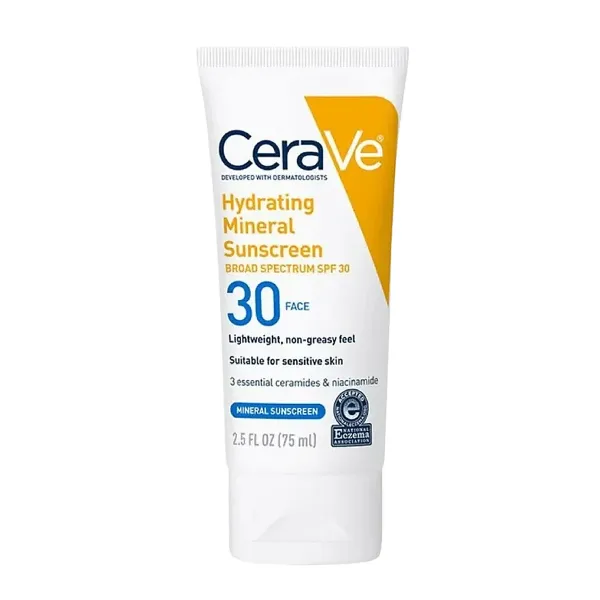
This amount matters for how long a bottle actually lasts. Used correctly, once a day, a sunscreen is a daily-use product, not something to stretch across months by applying a thin film. Rationing sunscreen to make a bottle last longer is one of the most common ways Pakistani buyers accidentally cut their real SPF protection in half. If cost is the concern, it is more effective to buy one correctly-priced sunscreen and use it in full than to under-apply an expensive one — for example, a mineral formula like CeraVe Hydrating Mineral Sunscreen SPF 30 used generously every morning protects better than a pricier SPF 50 applied too thinly.
Face, Neck and Ears: The Zones Pakistanis Skip
The two-finger amount is meant for the whole face and neck, but most people stop at the cheeks and forehead. Ears, the hairline, the eyelid margin (with a gentle, fragrance-free formula), the sides and back of the neck, and the jawline under a beard are the zones that get burned, tanned or age faster simply because they are skipped.
For men who shave, reapplying along the jaw after shaving is worth the extra few seconds. For women who wear a dupatta or scarf that shifts through the day, the exposed strip of neck and hairline underneath needs its own coverage, not just what falls under the fabric. A lightweight, fragrance-free mineral formula such as La Roche-Posay Mineral Sunscreen SPF 50 spreads thin enough across these smaller, curved areas — ears, nose bridge, under-eye — without pilling or catching in fine hair, which makes it easier to actually use the full recommended amount instead of stopping short once it starts to feel heavy.
| Product | What It Is | Price (PKR) | Best For |
|---|---|---|---|
| Cerave Hydrating Mineral Sunscreen SPF 50 Face Lotion | Mineral, no white cast | See current price on the linked product page | Sensitive, tanned skin |
| La Roche-Posay Mineral Sunscreen, SPF 50 | Fragrance-free mineral formula | See current price on the linked product page | Acne-prone, reactive skin |
| Neutrogena Sunscreen Broad Spectrum SPF 50 | Daily broad-spectrum lotion | See current price on the linked product page | Everyday two-finger use |
| Neutrogena Sheer Zinc Dry-Touch Sunscreen SPF 70 | High-SPF sheer zinc | See current price on the linked product page | Peak summer outdoor exposure |
| Cerave Hydrating Mineral Sunscreen SPF 30 Face Lotion | Lighter mineral SPF30 | See current price on the linked product page | Low-exposure, indoor-heavy days |
| Cetaphil Daily Facial Moisturizer with Sunscreen 15 SPF | 4 Ounce 118ml | Moisturizer with SPF15 | See current price on the linked product page | Bonus layer, not standalone |
Prices correct as of July 2026. Cash on Delivery available across Pakistan.
Body Sunscreen: The Shot-Glass Rule
Sunscreen amount rules don't stop at the face. For arms, hands, feet and any exposed body skin, the dermatology guideline is a shot-glass amount — about 30ml — for full body coverage in a single application. Most Pakistani wardrobes (shalwar kameez, sleeves, dupattas) already cover a large share of the body, so the practical version of this rule is to focus that amount on what's actually exposed: forearms and hands on a motorbike or rickshaw commute, feet in sandals or slippers, and the neckline below the collar.
Hands in particular are chronically under-protected in Pakistan — they're exposed to sun during every commute, at traffic stops, and while driving, yet almost nobody reapplies sunscreen to them. The same finger-length logic applies at a smaller scale: one full finger-length of sunscreen per hand and forearm, rubbed in like lotion, is a realistic daily habit rather than a full shot glass every morning. Keep a bottle in the car or bag if midday reapplication is realistic for your routine.
Climate Changes the Timing, Not Just the Amount
Pakistan's regions change how often you need to reapply, even if the two-finger amount stays the same. In Karachi's coastal humidity, sweat and moisture on the skin break down sunscreen film faster, so reapplying roughly every 2 hours during peak outdoor exposure (11am-4pm) is realistic in summer, especially for oily or combination skin.
In Lahore and Islamabad, drier heat allows the more standard 2-3 hour reapplication window on most days, but UV exposure stays high even in the cooler winter months when people assume sunscreen isn't needed — cloud cover and lower temperatures don't block UVA, the wavelength responsible for tanning and premature ageing. For anyone who washes their face multiple times a day, including for wudu, sunscreen needs reapplying afterward too, since washing removes the protective film. A well-tolerated daily formula such as Neutrogena Sunscreen Broad Spectrum SPF 50 is easy to reapply through the day without feeling greasy on top of an existing layer.
Choosing a Texture You'll Actually Apply Enough Of
The biggest barrier to using the full two-finger amount in Pakistan is texture — nobody applies a generous layer of something that leaves a visible white cast or feels heavy in humidity. Mineral (zinc oxide/titanium dioxide) formulas like CeraVe Hydrating Mineral Sunscreen SPF 50 and La Roche-Posay Mineral Sunscreen SPF 50 are formulated to sheer down on wheatish, tan and deep skin tones even at the full recommended thickness, which makes it realistic to actually apply two finger-lengths rather than skimping to avoid a grey tint.
For peak summer outdoor exposure — travel, weddings, long commutes — a higher-margin option like Neutrogena Sheer Zinc Dry-Touch Sunscreen SPF 70 gives extra buffer for the under-application that happens in real life. One caution: a moisturizer with built-in SPF, such as Cetaphil Daily Facial Moisturizer with Sunscreen SPF 15, is typically applied in a thinner "moisturizer" amount rather than a full sunscreen dose, and SPF 15 has less margin for error — treat it as a bonus layer on low-exposure indoor days, not a replacement for a dedicated SPF 30-50 on days with real sun exposure. Browse the full range in our Skin Care category to find a texture suited to your skin type.
Common Mistakes
- Applying a pea-sized dab instead of two full finger-lengths for face, neck and ears
- Skipping the ears, hairline, eyelid margin and back of the neck
- Treating a low-SPF moisturizer like Cetaphil's SPF 15 as a full sunscreen replacement
- Not reapplying after 2-3 hours outdoors, especially in Karachi's humidity and sweat
- Rationing an expensive sunscreen to make the bottle last longer
- Assuming winter or cloudy days in Lahore and Islamabad don't need sunscreen at all
Shop BigBasket.pk
Products Featured in This Article
100% authentic — Cash on Delivery across Pakistan



Frequently Asked Questions
How much sunscreen should I apply to my face in Pakistan?+
Use two full finger-lengths of sunscreen — one along your index finger and one along your middle finger, from tip to first crease — which comes to about 1.2-1.3 grams. That's the lab-tested amount needed to actually get the SPF number printed on the bottle, covering your whole face, neck and ears.
Does a thin layer of high-SPF sunscreen work just as well as more of a lower SPF?+
No. SPF numbers are only accurate at the tested thickness of 2mg per square centimetre of skin, so applying half the recommended amount roughly halves your real protection — an SPF 50 used too thinly can perform closer to SPF 15-20. It's more effective to apply a generous amount of a moderate SPF 30-50 sunscreen than a thin smear of a very high SPF.
How often should I reapply sunscreen in Karachi compared to Lahore or Islamabad?+
In Karachi's humidity and heat, sweat breaks down sunscreen faster, so reapplying roughly every 2 hours during midday outdoor exposure is realistic in summer. In the drier climates of Lahore and Islamabad, the more standard 2-3 hour window works on most days, though winter sun still carries UVA exposure that reapplication should account for.
Is a moisturizer with SPF 15, like Cetaphil's, enough sun protection on its own?+
Only for very low outdoor exposure days. Most people apply moisturizer in a thinner layer than a dedicated sunscreen dose, and SPF 15 already has less margin for error, so it works best as a bonus layer rather than your main protection — pair it with or swap in a dedicated SPF 30-50 sunscreen for real sun exposure.
How much sunscreen do I need for my arms and hands, not just my face?+
For exposed body skin — forearms, hands, feet in sandals, the neckline — dermatology guidelines suggest a shot-glass amount, about 30ml, for full body coverage, but most Pakistani clothing already covers a large share of the body. In practice, one finger-length of sunscreen rubbed into each hand and forearm before a commute covers what's actually exposed.
Why does my sunscreen leave a white cast even when I apply the full recommended amount?+
A visible white cast at full application usually means the mineral formula isn't finely milled for deeper or tan skin tones, not that you're using too much — the fix is switching texture, not applying less. Well-formulated mineral sunscreens are designed to sheer down fully even at the two-finger amount, so they don't force you to under-apply to avoid a grey tint.
The Short Version
TL;DR: Use two full finger-lengths of sunscreen (about a quarter teaspoon) for your face, neck and ears — that's the lab-tested amount an SPF 50 needs to actually perform like SPF 50. Reapply every 2-3 hours outdoors (closer to 2 in Karachi's humidity), and pick a texture that sheers down fully like CeraVe Hydrating Mineral Sunscreen SPF 50 so you'll actually apply enough of it — browse more options in our Skin Care range.
Related Reading
- → Nivea Sunscreen Price in Pakistan: The Honest Answer
- → Chemical vs Mineral Sunscreen: Best Pick for Wheatish Skin
- → Best Sunscreens in Pakistan — No White Cast Guide 2026
- → Best Sunscreen for Oily Skin in Pakistan 2026 — No White Cast, No Shine
- → Best Sunscreen in Pakistan: Top SPF Picks for Every Skin Type
- → Sunscreen in Pakistan: Best SPF Picks for Every Skin Tone
Price note: Prices mentioned in this guide are snapshots and may change. The linked product page shows the current BigBasket.pk price and availability.